
Deluxe Chess Set
£59.99
£50.99
15%
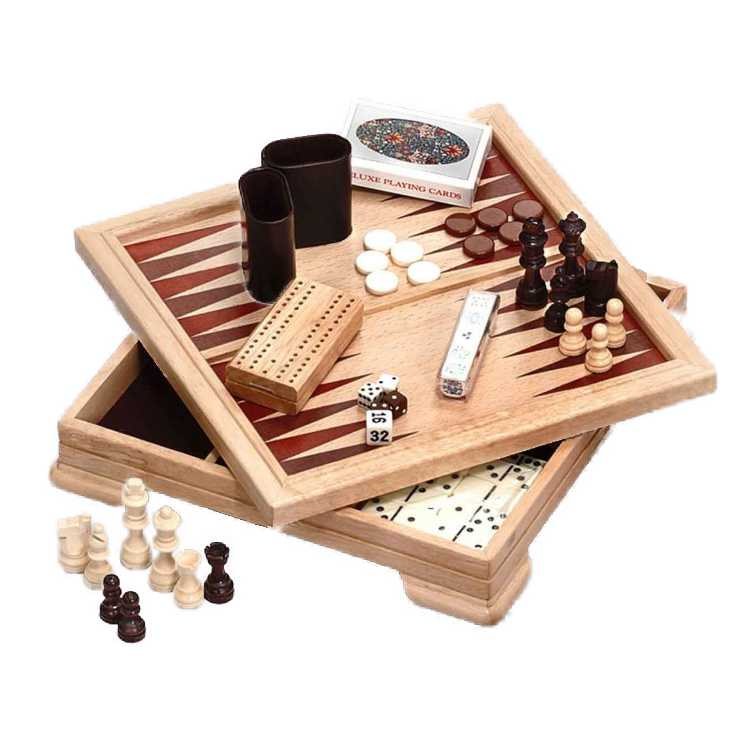
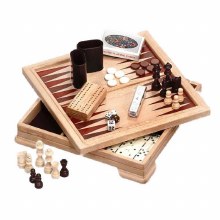
7 in 1 Deluxe Wooden Combination Game Set
Seven classic games in one beautifully produced package!
Supplied in full colour box, complete with new instruction booklet by David Pritchard. Set consists of a pack of playing cards, dominoes, cribbage board, poker dice and backgammon/chess/draughts.
DOMINOES
Dominoes is an ancient game played all over the world. The game consists of 28 tiles. Each tile is divided by a line across the centre separating the piece into two square halves. Numbers are represented in each half by spots, or in the absence of spots, by zero. 2-4 players lay down the tiles alternately. The game is over when one player has laid down all his pieces.
CRIBBAGE
Each player is dealt a hand of 6 cards, from which they discard 2 into a special pile called the Crib. One card is then cut from the draw pile and turned face up - it is considered part of each player's hand and of the Crib. The players then play cards in turn, scoring points for hitting certain totals, or for making sets or sequences. Score is kept by moving pegs along tracks on the cribbage board. This is repeated until both players have exhausted their hand of cards.
Next, each player picks up their hand and determines all possible scoring combinations, pegging points again on the cribbage board. The dealer then picks up the Crib and scores it for all possible points. Then the cards are shuffled and the deal alternates. The winner is the first to reach 121 points.
POKER DICE
Poker Dice is a dice game using five (5) special dice of the same name (Poker Dice). The dice have playing card values from a nine to ace, instead of the 1 through 6 pips on standard dice. Poker Dice can be played by any number of players and the rules for the game are very simple. Each player in turn gets up to three rolls of the dice to make the best standard poker hand, players put aside dice on each throw to build the 'hand' and the player with the best poker hand wins (suit has no relevance).
BACKGAMMON
Each player has a set of 15 checkers (or stones) that must be moved from their starting positions, around, and then off the board. Dice are thrown each turn, and each player must decide which of their checkers to move based on the outcome of the roll. Players can capture each other's checkers, forcing the captured checkers to restart their journey around the board. The winner is the first player to get all 15 checkers off the board. A more recent addition to the game is the "doubling cube", which allows players to up the stakes of the game. Although the game relies on dice to determine movement, there is a large degree of strategy in deciding how to make the most effective moves given each dice roll and measuring the risk in terms of possible rolls the opponent may get.
CHESS
Chess is a two-player, abstract strategy board game that represents medieval warfare on an 8x8 board with alternating light and dark squares. Opposing pieces, traditionally designated White and Black, are initially lined up on either side of the board. Each type of piece has a unique form of movement and capturing occurs when a piece, via its movement, occupies the square of an opposing piece. Players take turns moving one of their pieces in an attempt to capture, attack, defend, or develop their positions. Chess games can end in checkmate (when the king cannot escape from the opponent's pieces), resignation (when one player recognises that defeat is inevitable and ends the game), or one of several types of draws.
DRAUGHTS
Abstract strategy game where players move disc-shaped pieces across an 8 by 8 cross-hatched ("checker") board. Pieces only move diagonally, and only one space at a time. If a player can move one of his pieces so that it jumps over an adjacent piece of their opponent and into an empty space, that player captures the opponent's disc. Jumping moves must be taken when possible, thereby creating a strategy game where players offer up jumps in exchange for setting up the board so that they jump even more pieces on their turn. A player wins by removing all of his opponent's pieces from the board or by blocking the opponent so that he has no more moves.
Supplied in full colour box, complete with new instruction booklet by David Pritchard. Set consists of a pack of playing cards, dominoes, cribbage board, poker dice and backgammon/chess/draughts.
DOMINOES
Dominoes is an ancient game played all over the world. The game consists of 28 tiles. Each tile is divided by a line across the centre separating the piece into two square halves. Numbers are represented in each half by spots, or in the absence of spots, by zero. 2-4 players lay down the tiles alternately. The game is over when one player has laid down all his pieces.
CRIBBAGE
Each player is dealt a hand of 6 cards, from which they discard 2 into a special pile called the Crib. One card is then cut from the draw pile and turned face up - it is considered part of each player's hand and of the Crib. The players then play cards in turn, scoring points for hitting certain totals, or for making sets or sequences. Score is kept by moving pegs along tracks on the cribbage board. This is repeated until both players have exhausted their hand of cards.
Next, each player picks up their hand and determines all possible scoring combinations, pegging points again on the cribbage board. The dealer then picks up the Crib and scores it for all possible points. Then the cards are shuffled and the deal alternates. The winner is the first to reach 121 points.
POKER DICE
Poker Dice is a dice game using five (5) special dice of the same name (Poker Dice). The dice have playing card values from a nine to ace, instead of the 1 through 6 pips on standard dice. Poker Dice can be played by any number of players and the rules for the game are very simple. Each player in turn gets up to three rolls of the dice to make the best standard poker hand, players put aside dice on each throw to build the 'hand' and the player with the best poker hand wins (suit has no relevance).
BACKGAMMON
Each player has a set of 15 checkers (or stones) that must be moved from their starting positions, around, and then off the board. Dice are thrown each turn, and each player must decide which of their checkers to move based on the outcome of the roll. Players can capture each other's checkers, forcing the captured checkers to restart their journey around the board. The winner is the first player to get all 15 checkers off the board. A more recent addition to the game is the "doubling cube", which allows players to up the stakes of the game. Although the game relies on dice to determine movement, there is a large degree of strategy in deciding how to make the most effective moves given each dice roll and measuring the risk in terms of possible rolls the opponent may get.
CHESS
Chess is a two-player, abstract strategy board game that represents medieval warfare on an 8x8 board with alternating light and dark squares. Opposing pieces, traditionally designated White and Black, are initially lined up on either side of the board. Each type of piece has a unique form of movement and capturing occurs when a piece, via its movement, occupies the square of an opposing piece. Players take turns moving one of their pieces in an attempt to capture, attack, defend, or develop their positions. Chess games can end in checkmate (when the king cannot escape from the opponent's pieces), resignation (when one player recognises that defeat is inevitable and ends the game), or one of several types of draws.
DRAUGHTS
Abstract strategy game where players move disc-shaped pieces across an 8 by 8 cross-hatched ("checker") board. Pieces only move diagonally, and only one space at a time. If a player can move one of his pieces so that it jumps over an adjacent piece of their opponent and into an empty space, that player captures the opponent's disc. Jumping moves must be taken when possible, thereby creating a strategy game where players offer up jumps in exchange for setting up the board so that they jump even more pieces on their turn. A player wins by removing all of his opponent's pieces from the board or by blocking the opponent so that he has no more moves.
Share:
Share on Facebook Share on Twitter Share on Pinterest Tell a friend